Review by Holly Champion. Two and a half stars **1/2
Intrigued to hear about a new Australian work based on Puccini’s beloved La Bohème, and also motivated by loyalty as my friend James Oberg was performing in the chorus, I attended the opening performance of Bohème, a piacere on Friday the 9th of November. Presented by Divas on Demand, this show can best be described as a kind of immersive cabaret mashup or ‘post-operatic’ work based loosely on Bohème and featuring extra songs from mid-century France, some jazz standards such as Autumn Leaves, and some hits by The Andrews Sisters. Overall, this was a very interesting and innovative, postmodernist concept that is to be applauded, particularly as it is coming from within the famously conservative world of opera.
However, it did not quite meet its potential in realisation. This was partly due to some strange choices made by director Nathan Gilkes and by writer/arranger (and accompanist and Artistic Director) Wendy Dixon, but it was also in large part due to having a cast with uneven levels of ability.
The show was hampered, as is ever the case in amateur and semi-professional opera performance, by a lack of male performers. The three men here included a disappointing Bohème Rodolfo in Erik Chai, whose fairly pleasant timbre does little to offset his significant intonation and breath support problems, vocal smallness and mediocre stagecraft skills. While there are indeed arguably some divas on demand here, such as the rather wonderful and promising young soprano Mikayla Tate as Bohème Musetta, there are no true divos. The charmingly amiable Ceri Aubrey’s sizeable lirico-spinto tenor lent him moments of glory, but his performance as Future Rodolfo was marred by a number of flat high notes. My friend Oberg did well despite his tonsillitis, and was the only one of the three men to have unerring intonation, but he only had one small solo. He cannot be expected to carry a lead role yet as he has only been studying voice for eighteen months. Neither Oberg nor Chai have voices that will probably ever be of suitable size and weight for Puccini, and they did not match those of the rest of the cast, who had bigger, more operatically trained voices– though while Olivia Morberger as Bohème Mimì is pleasant to listen to and a good actress, she does not really have the right instrument for Puccini either.
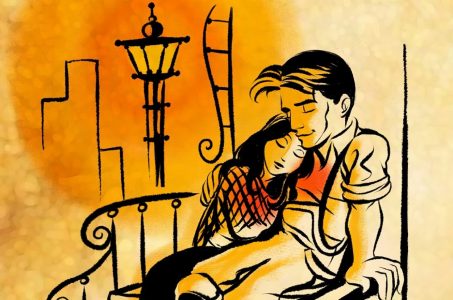
This mixed cast were packaged in glamorous 1940s-style costumes, which worked well from the perspective of the cabaret café setting and, indeed, the cabaret genre of Bohème, a piacere itself. However, the costumes added an extra level of confusion to an overall directorial concept that was already bewildering. As readers may have already gathered, the show included not one but two sets of Mimìs, Rodolfos and Musettas. There was a younger cast (in their twenties) and an older (in their forties or fifties). The premise, as explained in the program notes and briefly by director Gilkes at the outset, was that the older characters ‘remember’ or ‘dream’ about their younger selves. I don’t know why they were termed ‘Bohème’ and ‘Future’ instead of ‘Younger’ and ‘Older’, because with all costumes being from the 1940s, the older characters could hardly be said to be from the future; and with this design choice, the time lapse was not visually clarified. It was not communicated very well in terms of blocking either, and Puccini’s musical material was generally simply split amongst the younger/older performers, with little apparent change in the libretto or score to reflect the process of remembering/dreaming. To make matters even more perplexing, Mimì of course dies young (sorry, spoiler) so her older self is merely a dreamlike projection, imagined by Future Rodolfo and by Future Musetta (Andrea Quaglia)— who charismatically opens the show as a world-weary cabaret singer. At least, I think Future Musetta co-dreams with Future Rodolfo; it was hard to tell what was going on.
This brings us to the central problem that made Bohème, a piacere nigh on incomprehensible: most of the show was sung in the original Italian (or French) with no surtitles. Normally I advocate passionately for amateur and semi-professional opera productions to be performed in the original language with surtitles (e.g. here and here) but in this case surtitles were basically an impossibility, as the audience moved with the performers through different spaces during the show, and sat or stood where they liked. Some short segments, notably in the final tragic scene, were sung and spoken in English, so it is clear that the creative team had no real objection to translation per se. While audiences could be expected to be familiar with Puccini’s original opera to some extent, we cannot be expected to either understand Italian or know the opera well enough to know what the characters are singing about at any given point. Translation into English was the only logical option, and I cannot understand why it was not consistently done.
To more clearly communicate the younger/older character premise through design, the older cast could have been wearing costumes from, for example, the ’60s. An even better alternative approach would have been to have the younger cast wear ’20s fashions. Reviewer Alan Hartstein, writing for Sydney Arts Guide, suggested here that this was the case, but I beg to differ. Though the mens’ costumes were admittedly indeterminate, apart from the ’40s dresses, the women were nearly all sporting ‘victory rolls’ in their hair, which is an iconic wartime pin-up look. I suppose Gilkes wanted to keep the overall look of the show within the ’40s style to match the Art Deco surrounds of the Independent Theatre, but the ’20s would have worked just as well.
The bare-bones set and blocking utilised the surrounds nicely, though I didn’t feel that the Independent was truly the best venue for the purpose, as it is quite opulent, whereas the bohemians are notoriously impoverished. I would suggest something like Marrickville’s Factory Theatre for next time, which could be part of an attempt to attract new, younger audiences to opera. (Genre mashups, cabaret and vintage looks tend to do well among the youth and middle-aged of Sydney’s Inner West!) The lighting was also often too bright at The Independent, particularly for the opening ‘speakeasy’ and the love scene from Act I, in which Mimì and Rodolfo’s hands are supposed to meet while searching for her lost key in the dark. The Act III portion was performed outside, so at this evening performance it had moodier lighting. This was more appropriate for this heartbreaking scene in which Future Lucia and Future Rodolfo sadly part ways and Musetta and Marcello fight (here, Marcello is turned into a Marcella, due no doubt to the lack of male performers, but I remain baffled as to whether they were supposed to be in a same-sex relationship). However, at Saturday’s matinée this scene would have been in full daylight, which would not suit the mood at all.
Dixon accompanied beautifully on piano and keyboard through most of the performance, with Gilkes assisting. Acoustic guitarist Grant Sambells was brought in purely for the Act I love scene— taken on its own merits, the guitar accompaniment was lovely and effective, but it stood out oddly within the overall musical scope of the show. While the show’s bricolage of musical genres was exciting, many of the ‘joins’ between the various numbers had rather obvious sudden key changes, and I feel it would have been more elegant to compose more original material, for a seamless effect. Perhaps it would have been better to have the entire show accompanied by guitar or another instrument(s) that can be moved easily from place to place along with the cast. While I found the proliferation of keyboards at strategic points amusing, being a piano snob I generally despise the things, and I felt they jarred visually and aurally with the period-piece nature of the show. The only scene that I felt really worked was the only one that featured a real piano– the Café Momus scene, which was performed in The Independent’s main foyer, and was introduced quite delightfully by three ladies singing “the café café café café café Momus” to the main refrain of The Andrews’ Sisters 1941 hit “Boogie Woogie Bugle Boy”. I felt that Gilkes could have gone further with the potential for audience/performer interaction, particularly in this jovial scene. Such interaction could be very achievable if everything were in English, and especially if more of the sections were rendered in spoken dialogue.
I was not aware of the much-needed program notes until after the performance; these were not distributed in programs but merely printed on tiny standing posters in the ‘speakeasy’, and nobody directed our attention to them. If I had read these before the show began, I would have been clearer on the action and the premise. However, even with the benefit of the notes and hindsight, I remain confused, and I probably have more background knowledge than most, having seen at least eight full Bohème productions over the years, including two others just in the past six months. I don’t pretend to know everything about opera or Bohème, but really, I should have been able to understand what was going on. Unfortunately, the singing was often not good enough to allow one to simply luxuriate in the sound, either. That said, both the Musettas (Tate and Quaglia) had standout moments of vocal and dramatic power, as did Aubrey and lirico-spinto soprano Suzi Stengel in their Future Rodolfo/ Lucia duets.
Bohème, a piacere translates to ‘to one’s taste’ and idiomatically means ‘a loose interpretation’. This one is quite fresh and interesting, and whilst I have made a lot of criticisms in this review, I do feel it has plenty of potential. It needs to be reworked in English, with a more consistent cast, more men, a grungier venue, better lighting, more through-composed and artistically coherent accompaniment, more communicative visual design, and possibly more audience/performer interaction. Though it was not entirely ‘to my taste’, I eagerly await the next iteration of this show from this creative team… or perhaps even… Traviata, a piacere?