Review by Holly Champion. Four out of five stars ****
I met the extraordinary singer-vocal coach-director-entrepreneur-writer-composer-pianist (and, rumour has it, also -medical doctor?!) Christina Henson a few months ago, and it is clear that this recent import from the States is shaping up to be a real force to be reckoned with in the Australian opera scene. After coaching for three full operas on NSW’s Central Coast, Henson has now assembled a troupe of mostly young, emerging artists to create Outlaw Opera, a new professional-training opera company that seems to have as much chutzpah as its creator, and an apparent focus on the dastardly, the dark and the delicious of the operatic canon.
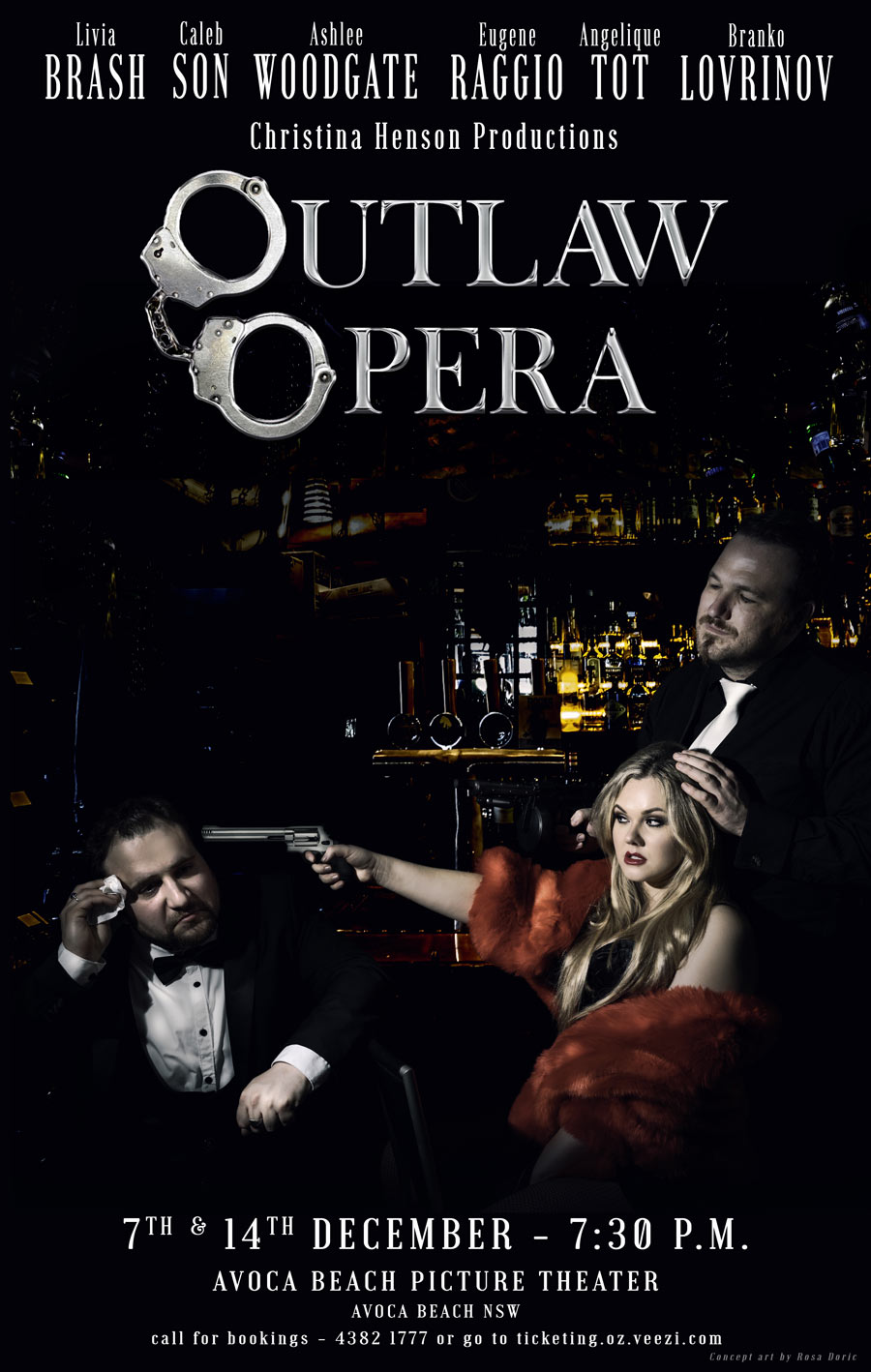
I attended Outlaw Opera’s inaugural self-titled show at its second performance on Friday the 14th of December. I expected a concert (or, based on the promotional images, perhaps a new Wild West opera) but to my delight this turned out to be a collection of fully-staged and costumed scenes, accompanied by the excellent young Noah Peres on piano.
It was a surprise to suddenly hear the piano—in keeping with the dark themes, the adorably vintage Avoca Beach Picture Theatre was almost entirely blacked out and I couldn’t see Peres. There was no way I was going to be able to take my usual notes, so I settled back to just enjoy the show. On to the small stage stalked Mario Bellanova as Baron Scarpia in a splendid costume courtesy of Gosford Musical Society, opening the ‘concert’ with theTe Deum from Act I of Puccini’s Tosca. I instantly sat up, partly because Tosca is my favourite opera, and partly because Bellanova, a seasoned soloist whom I had never heard before, proved from the opening notes why this is his signature role. His Scarpia is close to perfect—a dark-hued, burnished and powerful instrument, lovely phrasing and clear diction, the right ‘look’ with his Mediterranean colouring and brooding eyebrows, and some of the most wonderfully malevolent and interesting acting I have seen on the operatic stage.
After this impressive start, we had the young rising star Livia Brash scheming as Lady Macbeth with “Vieni, t’affretta!” from Verdi’s version of Shakespeare’s ‘Scottish Play’. Brash’s big, beautiful, well-controlled spinto soprano lent this cruel character an appropriate lushness and potency. (I do often wonder about nominative determinism, but happily, this particular artist tends to disprove the theory). After Macbeth we had a scene from Bizet’s Carmen, with the impressive triple-threat Mariana Poghosyan as the titular gypsy, and Caleb Son as the hapless Don Jose, powerless to resist this Carmen’s seductive, wonderful dancing, beautiful phrasing and general gorgeousness. It was just a slight disappointment that her timbre was a little on the thin side for this role, especially when compared directly with Son’s vocal richness, which was really on display with his beautiful presentation of the aria “La fleur que tu m’avais jetée”.
We were then treated to a fascinating version of “Regnava nel silenzio” from Act I of Donizetti’s Lucia di Lammermoor, as young soprano Ashlee Woodgate (as Lucia) sang to Poghosyan (as her maid Alisa) about a ghost girl who haunts the fountain where she was murdered. Woodgate looks great, is an excellent actress and has loads of vocal talent, and she acquitted herself admirably with a fiendishly difficult aria. However, as with Poghosyan as Carmen, I take some issue here with Henson’s casting and programming: Woodgate’s lovely instrument does not seem to be ideally suited to this repertoire, as her stratospheric high notes lacked bloom. I would guess it is more of a lyric soprano, rather than a natural coloratura voice; however, Woodgate is still very young, her technique is otherwise sound, and her top register may develop. It is also unfortunate that this choice of aria invites comparison with coloratura superstar Jessica Pratt’s recent near-flawless turn as Lucia for Opera Australia. Carmen and Tosca on the other hand are presented so often and in so many places that this (I admit, wholly unfair) ‘comparison’ effect is mitigated.
As with all the scenes in this show, a sparse set for Lucia was more than compensated for by wonderful digital backdrops, including beautiful, detailed photographs and video by Rosa Doric and clever animations by David Dean. Woodgate herself appeared in the video animation, projected behind Woodgate the live singer. Veiled in white, Woodgate as the ghost emerged eerily, having been digitally merged with a perfectly chosen image: a statue of a veiled woman. As the same character, Woodgate was also depicted falling backwards dramatically into the water as the girl/Lucia is killed. As opera-goers will know, though this ‘concert’ did not include it, this imagery brilliantly presaged Lucia’s own later appearance in a bloodied white veil, and her eventual demise– sheer directorial genius on Henson’s part. Previously in this ‘concert’, Bellanova’s performance of the famous lines “Scarpia is nesting in your heart / On your way, Tosca / Scarpia will set the falcon of your jealousy flying” in the slow-burning Te Deum had been accompanied by video– superimposed over the image of the Sant’Andrea della Valle church– of a frighteningly realistic falcon swooping down in slow motion with claws outstretched, as if to attack the audience. If Henson is able to retain the talented Doric and Dean on her team, Outlaw Opera will save a fortune otherwise spent on physical sets, will develop ‘digital set’ design and direction alongside Opera Australia’s more technically advanced forays into this field, and will help accustom emerging singers and designers (and directors, one hopes) to working with them. The audience stand to also really benefit from many inventive moments of interplay between text, action, music and digital design, such as we saw here.
After interval, I happily immersed myself in Tosca again, watching as Brash excelled in her role as the eponymous heroine, with her gorgeous voice and fine acting chops really getting a workout through Henson’s sensitive coaching and direction. Resplendent in a glamorous (if historically inappropriate) red gown, Brash brought a lovely combination of youthful vulnerability, physical beauty, and a tangible sense of personal power to her interpretation of the passionate diva. She is well on her way to crafting a Tosca worthy of international attention. While the minor roles of Spoletta and Sciaronne were sung by tenor-pianist James Doig and Henson’s credited “enabler” and husband, baritone Grant Hayes, Caleb Son seemed to be the only spinto tenor performing in the troupe on this Friday night, so he again featured, this time as the unlucky hero Cavaradossi. The grandiose (and for many tenors, terrifying) high notes “Vittoria! Vittoria!” were not quite what one would wish for on this particular evening, but Son is a highly talented and hardworking young artist with a glorious timbre and considerable charisma, who may indeed one day sing Cavaradossi on the international stage. And once again, I revelled in Bellanova’s finely-tuned interpretation of the evil Chief of Police. From what I hear, he is also a kind and generous mentor to young artists, and his endearing kiss on Livia Brash’s hand during their bows certainly showed warmth and respect for his young co-star.
The whole troupe and the inimitable Henson are to be congratulated on an impressive debut offering. It was well worth the long drive up from Sydney on an evening that was so stormy as to put the trains out of action. The program notes ask for donations—alas, if I had more than an emerging artist’s salary I would willingly give. But I eagerly anticipate what Outlaw Opera will come up with next. Perhaps they will explore some of the more ‘outlawed’ operas that do not take pride of place in the canon? Or will they go further with the Wild West theme and give us a digital La fanciulla…? It is certainly worth attending, whatever it is. Four stars for this one.