Review by Holly Champion, 27 August 2018. Three and a half out of five stars.
On Saturday I was unexpectedly asked to review Central Coast Opera’s new production of La Bohème, very late in its run—mainly so that the young artists could get feedback. I was delayed by Sydney traffic, but arrived just in time for the beginning of the Act I love duet. This Bohème is helmed by the young director Warwick Doddrell and well-established MD, Central Coast Conservatorium’s Artistic Director/ CEO Patrick Brennan, and it is a sumptuous, romantic and effective, if rather derivative, feast for the senses. It boasts a really gorgeous, complex lighting design by Damien Rice, lovely colourful mid-20th-century costumes by Kelly Denley and Janelle Fischer, and a veritable army of vocal coaches, repetiteurs and consultants behind the scenes. It is trumpeted by Brennan’s program notes as “by far the most ambitious opera project produced by the Central Coast Conservatorium under the banner of Central Coast Opera”. It is indeed a very large undertaking, and along with a large, soprano-heavy chorus, it is double-cast. I saw the ‘Beauvoir’ cast, which is mixed: some emerging opera stars, an accomplished tenor experiencing a bad night, and a wonderful musical theatre performer who is a little out of his depth…all slightly hampered by a strange sound design.
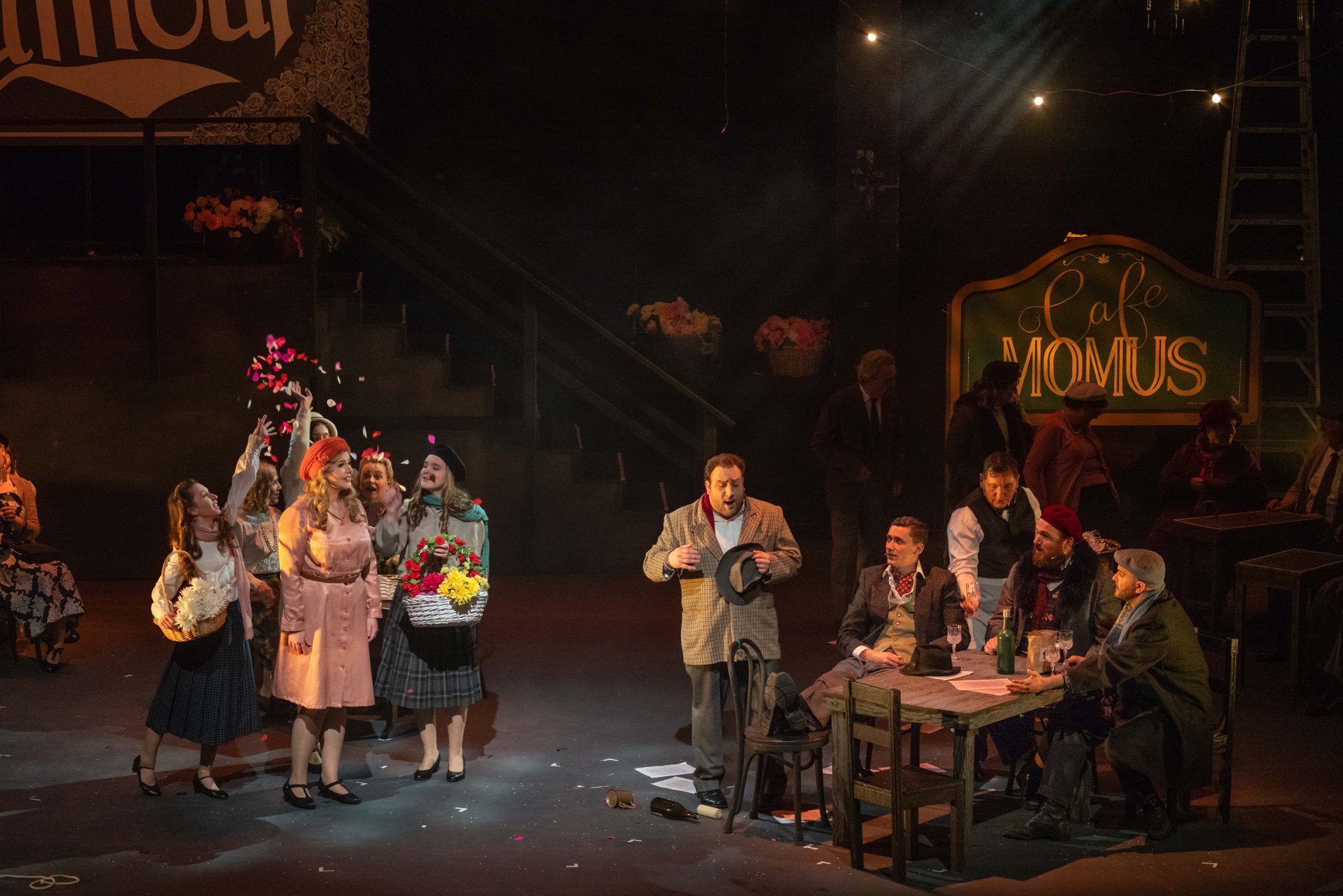
Livia Brash as Mimi, Branko Lovrinov as Rodolfo, with principals and ensemble in Act II.
Obviously inspired by Baz Luhrmann’s famous 1990 production for Opera Australia, with a fair bit of OA’s recent HOSH production by Andy Morton thrown in for good measure, Doddrell’s vision is that of an impoverished, wintry postwar Paris. The references to the departing Nazis and the pain of war add a fresh element of drama and suffering to this, the most frequently trotted-out of operas. Marcello here is a returned serviceman, which makes some sense of his disturbingly violent behaviour towards Musetta, and there are visual references to Benoît being a Nazi, which somewhat excuses the young bohemians’ scurrilous attempts to get out of paying the rent. The main Baz Luhrmann elements here are in the set, designed by the multi-talented ‘Monet’ cast Rodolfo, Simon Castle. He and Doddrell have shamelessly borrowed Luhrmann’s iconic ‘Coca-Cola’-esque “L’amour” sign, which also prominently featured in Luhrmann’s 2001 La Bohème / La Traviata jukebox mashup film, Moulin Rouge! (You can watch the Act I love duet from Luhrmann’s La Bohème here.) As if it weren’t already attention-grabbing enough, Doddrell’s L’amour billboard here has a prop thrown at it that ‘breaks’ its light, and has a character ‘re-painting’ it in Act III. Frankly, I wouldn’t mind this cheeky postmodern appropriation at all if only Doddrell had given due credit, but Luhrmann’s name is nowhere to be found in the program notes. Instead, Doddrell cites Bressaï’s black and white photographs of Paris’s underworld as his visual inspiration. The set is certainly beautiful and iconic, and it is used very effectively in terms of blocking; Doddrell shows real talent in co-ordinating a large cast and creating interesting shapes and emotional variety. Like Luhrmann and Morton, he has made great use of a large, grubby, angled garret window, which descends from the flies, as does an ornate streetlamp in Act III. Café Momus is nicely rendered in Act II with chairs and tables and the artists’ chalkboard, which is flipped to reveal the name. In Act IV, the chalkboard is home to Marcello’s painting, which is a bizarrely floppy canvas that is barely held up properly (so easy to fix—why?). A single bed completes the set, and this potent image of l’amour itself is bounced on riotously by the bohemians in Act IV before the entrance of the girls, whereupon it is the site for Mimì’s tragic end.
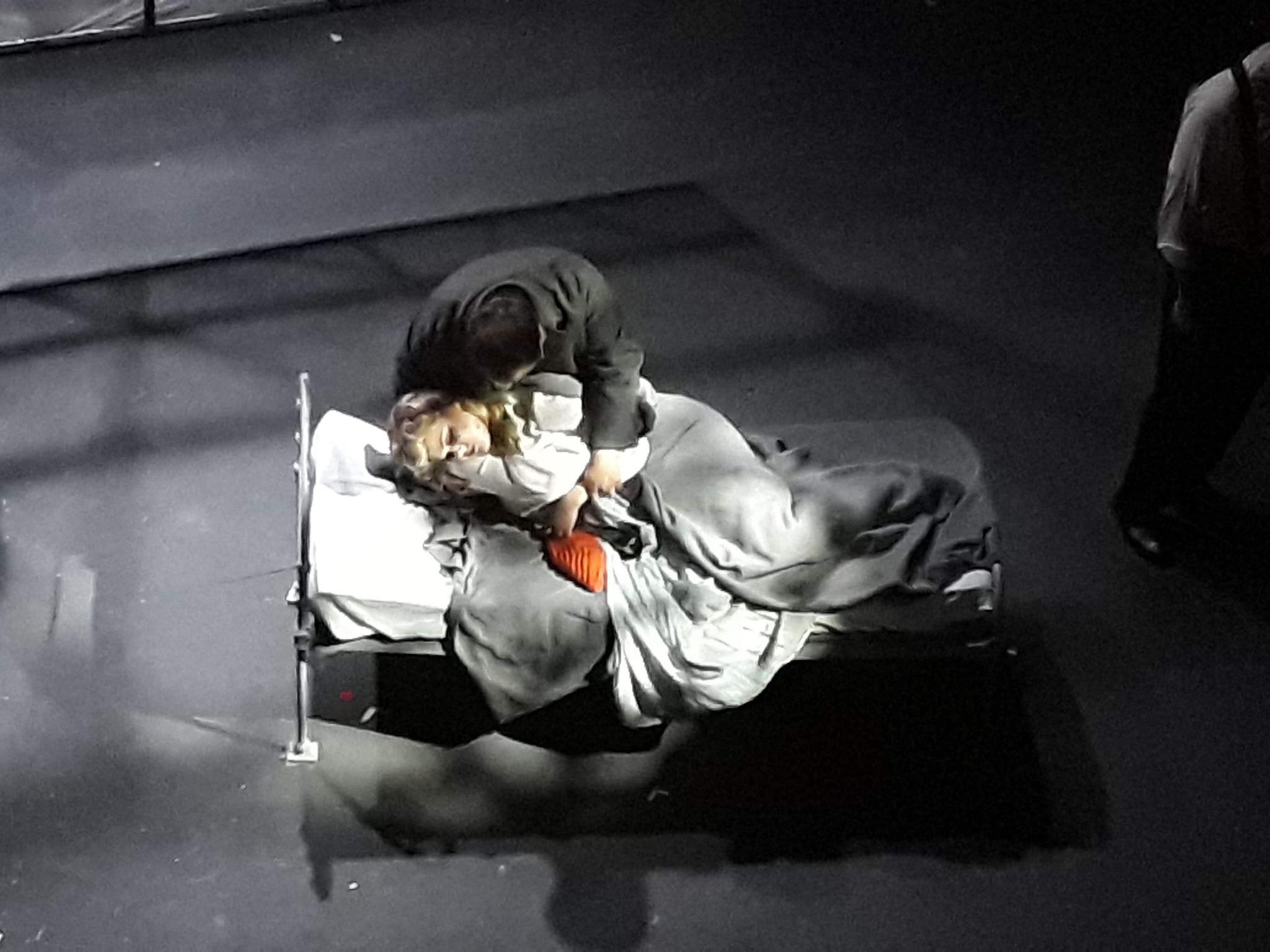
Livia Brash as Mimi and Branko Lovrinov as Rofolfo. Image credit: Nicola Morley
Notwithstanding a wonderful visual style, the highlight of this production is undoubtedly its ‘Beauvoir’ cast Mimì, the 26-year-old Livia Brash, who is a real star in the making. In addition to looking good and being a sensitive, confident actress, her huge, glorious and beautifully controlled young spinto soprano soars above everything. Its size was an especial boon at this performance, as it often drowned out her poor Rodolfo. Branko Lovrinov exhibited a lovely lower register, but on Saturday night he rasped and even outright cracked almost every time he ventured above a G or an A. He must have been quite ill, as he obviously has a lot of training, experience, musicality and otherwise seemingly good technique, but given that the show is double cast, I wonder why Simon Castle was not called upon in Lovrinov’s time of need. I have to assume Castle was not available, and while there are always plenty of sopranos to go around (here, both Mimì and Musetta have covers), it is notoriously hard to replace a Rodolfo—there is certainly nobody suitable in the chorus, which suffers from a lack of adult male voices. One of these days I will get around to writing a blog post on my theories as to why more women than men are interested in performing.
As the tormented Marcello, baritone Alex Sefton is excellent, moving with great charisma, and showing off his honed technique and pleasing, rich instrument. Young Hannah Greenshields as Musetta is vocally quite dazzling, and while I could wish for slightly more physical grace in her arm and shoulder movements (I recommend ballet training) she makes a lovely, appropriately sexy Musetta with tons of future potential.
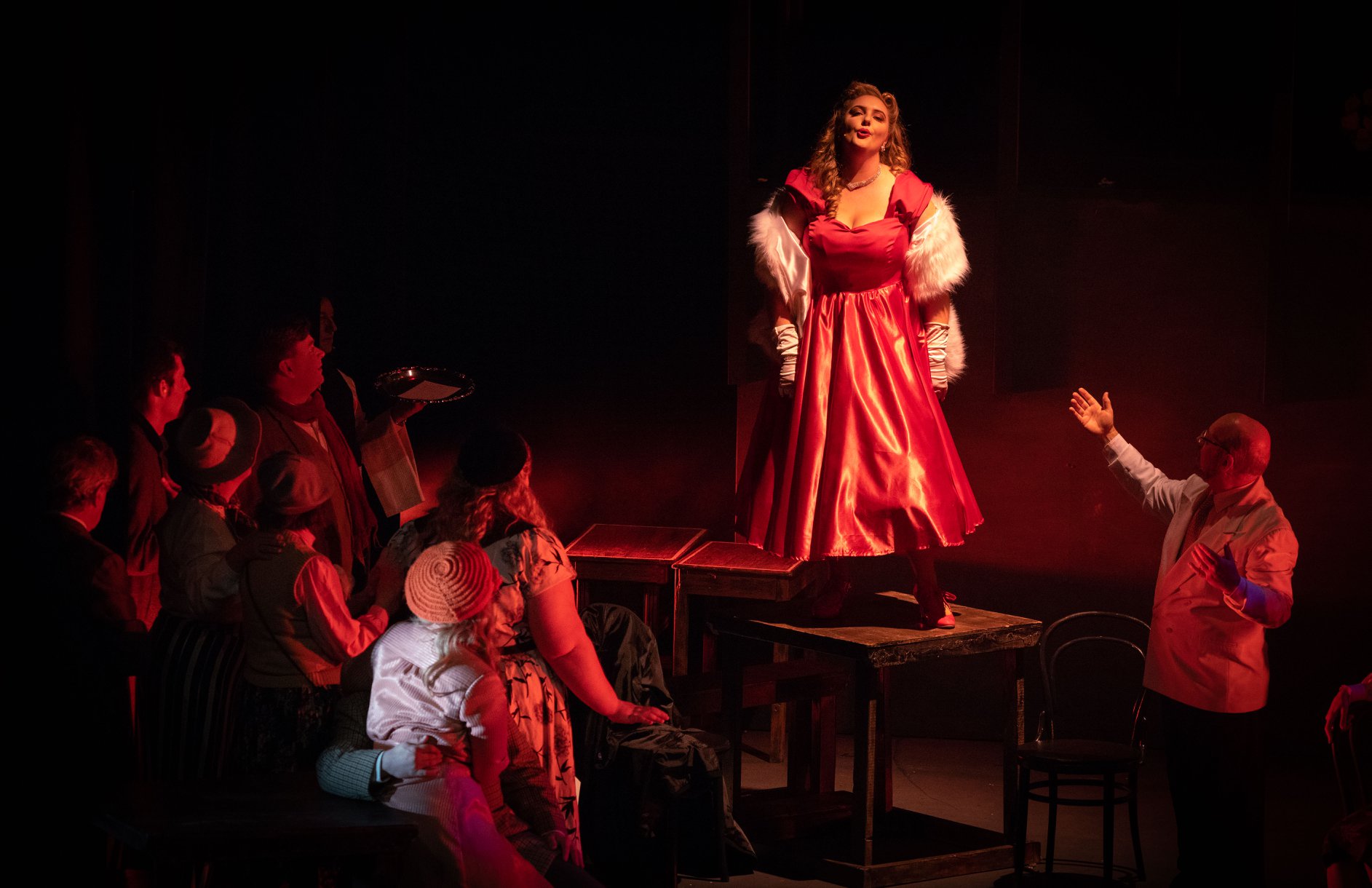
Hannah Greenshields as Musetta, surrounded by admirers in Act II.
Bass-baritone Eugene Raggio is a wonderful Colline, who really tugged at the heartstrings with his ode to his beloved coat, and Jayden Castle made for a decent and very entertaining Schaunard, though he is really a musical theatre performer and thus doesn’t quite fit among the bigger operatic voices of the other principals. (Was it a single Castle dynasty involved in this show? Nicole Castle is also credited as AD / Production Manager, and Simon’s father Colin Castle as set builder!)
With such a generally strong cast, and a small but balanced orchestra that is sensitively and confidently conducted by Brennan, I have to wonder why the decision was made to mike the principals. While Gosford’s Laycock Street Theatre is admittedly designed more with musical theatre in mind, it is not very large, and these big voices surely do not need any assistance projecting to the back of it, especially over an orchestra of this size. The ensemble performers here are also not miked—when they are the ones that need it, if anyone does! I suppose the audience benefits somewhat from the increased text clarity that comes from using microphones, but we certainly did not benefit from the occasional spate of horrible white noise, which is so often a problem in community shows I have seen that have featured miked casts. Emerging operatic artists also do not gain much professionally from the experience of singing indoors with a microphone. If they do happen to be interested in doing crossover work, which is very sensible given the current operatic climate, then the appropriate show in which to mike them would be an operetta (e.g. Fledermaus, Merry Widow, Gypsy Baron or G & S) or a high-end musical (e.g. Les Mis, Phantom), but not grand opera like La Bohème, which is only ever miked in professional opera companies in the case of outdoor productions like HOSH. In addition (as I have banged on about before here) while I actually really liked this amusing new contemporary translation by Amanda Holden, young operatic artists also do not benefit much from singing in English. I would really advise Central Coast Opera to get surtitles and ditch both the translations and the mikes, unless they want to stage operetta.* Perhaps they could install a nice general ‘acoustic resonance’ system, if they can raise the funds.
Despite the issues with illness, sound and plagiarism, overall this is a very clever, sensitive, lush and romantic production of Bohème. Sadly, it has now come to an end as of yesterday—I really should have written this entire review in the past tense. But I am certainly impressed enough to bother heading up to Gosford again next year to see what Brennan and his team come up with next. I will also follow the careers of Brash, Sefton, Greenshields and yes, Doddrell with some interest in the years to come. Three and a half stars from me for this one. *** ½
___
*In fact, I hope they do stage Fledermaus next year. That would be great fun and have excellent appeal to Central Coast audiences, and Brash would make a fabulous Rosalinde, if she hasn’t escaped to greener operatic pastures by then. I am going to be even cheekier here and suggest Ian Warwick’s wonderful 2017 Great Gatsby-esque production for Operantics, which I think could use a second outing, though I would do it all in English, as I find bilingual productions fascinating but also very jarring.