Review by Holly Champion. Four out of five stars ****
Firstly, let me apologise for the late publication of this review. I usually try to get reviews out the day after the show – but in this case, I was too busy playing an outrageous Brooklyn flapper in Beyond Cinema’s immersive Great Gatsby show. Ah yes, the dangerous game of writing reviews while also being an artist, and when you invariably end up reviewing your friends—that deserves a whole blog post unto itself. But… you are here for a review, so here it is.
Rockdale Opera is rather unusual in that it is an opera company established by a city Council, rather than by bunch of opera lovers, as were Opera Australia and many others. Rockdale deserve a hearty congratulations on reaching their 70th year in 2018—this not-for-profit is the oldest opera company in continuous operation in Australia. They generally produce at least one full opera and a concert or two per year; I have now seen five of their offerings and been involved in one. The operas are consistently good pro-am productions, sung in English. (More on my beef with that later). Audiences seem to be mostly opera-loving retirees, along with some performing arts professionals and the performers’ families and friends. Nobody is paid* and all proceeds go back into the company. As with most pro-am companies, while the chorus is amateur, the main casts and creative teams are composed of a mix of emerging young opera professionals and older pros/ ex-pros. This production of Offenbach’s Tales of Hoffmann is fairly typical of Rockdale’s quality offerings, but the sheer number of talented performers in its main cast is even more impressive than usual.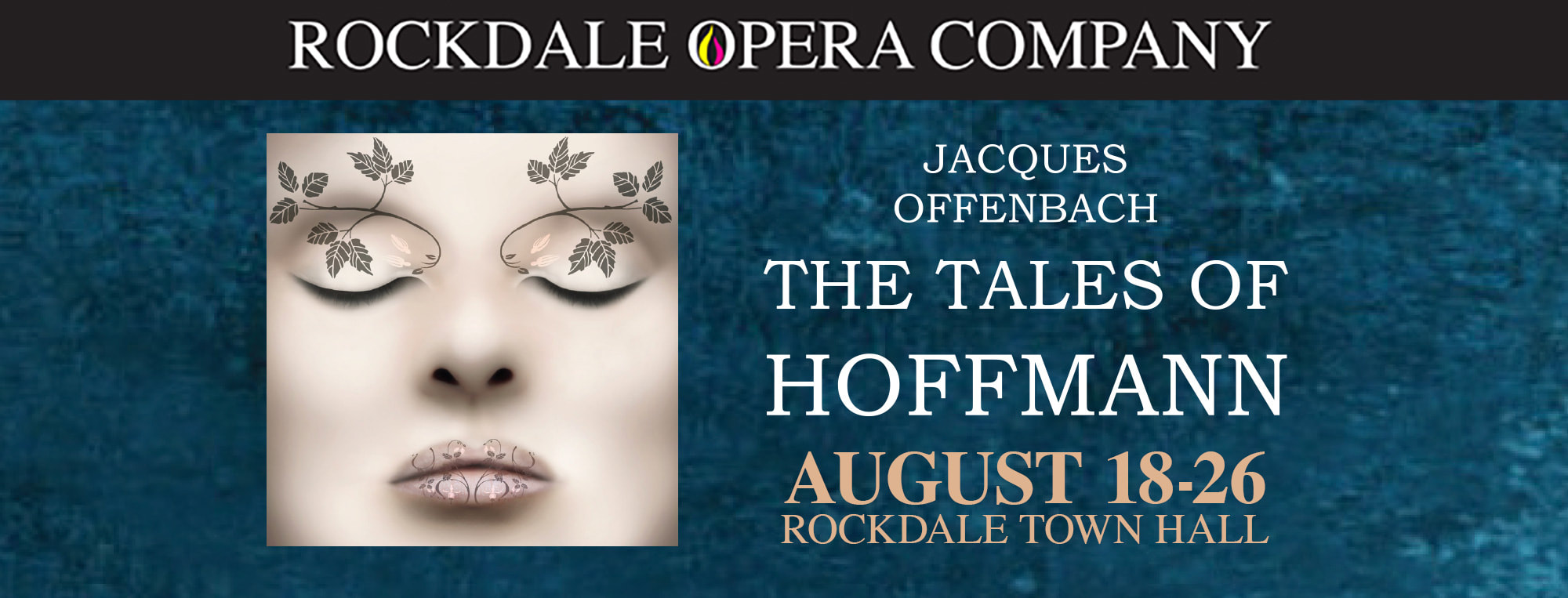
In this anniversary year, Rockdale have contracted a very well-credentialed creative duo to mount this beloved work. Director Dr David Brennan is a former Principal Artist baritone with OA, and the young rising star conductor Luke Spicer is currently OA’s NSW Schools’ Tour music director. As Brennan’s erudite programme notes inform us, this is the last opera Offenbach wrote and was his attempt at moving away from the lighter repertoire for which he became famous, into grand opera territory. This is very appropriate for Rockdale, who specialise in operetta, light opera, and what might be described as the ‘lighter end’ of grand opera. Les Contes d’Hoffmann (its original title) is based on three fantastical short stories by E. T. A. Hoffmann (1776-1822), reimagining the author as the hero. Each tale has its own Act, and each focuses on one of Hoffmann’s supposed past loves: an automaton named Olympia, which Hoffmann realises is not a real girl when his magical spectacles fall off; the dastardly Venetian courtesan Giulietta, who seeks to steal Hoffmann’s reflection; and a sweet but sickly girl, Antonia, who sings herself to death. The Prologue and Epilogue function as a framing device, in which the older, now jaded and drunk Hoffmann tells these stories from his past to a pub full of laughing onlookers, and Hoffmann’s Muse appears in female form, encouraging him to pour his torment into his writing.
The history of Hoffmann’s creation and performing editions is quite complex. This offers plenty of room for scholars to get excited and, importantly, for creative teams to justify chopping and changing things around— in a way that the opera world’s prevailing Canonical ‘great composer’ modus operandi won’t usually allow. Brennan is both scholar and artist, and avails himself fully of this creative freedom. For this edition, the libretto is translated from Jules Barbier’s French into English by Edward Agate, with some additional lyrics or dialogue from the Gutman edition and some straight from Brennan’s pen. Brennan states that he and Spicer “felt it important to keep the evening short, given the limitations of a small orchestra and a small theatre” and that “for this reason, we have replaced some recitative sections with condensed dialogue”. While I always find unaccompanied spoken dialogue jarring in opera, particularly when it opens the show as it does here, in general using dialogue was a good decision. Their Hoffmann is slightly long as it is, and the average Rockdale audience member’s patience and/or ability to stay up late only holds out so far. The creatives have also decided to present the Venice scene with its famous Barcarolle as Act II rather than Act III, because, as Brennan states, “while it offers a treasure trove of music, it is the least developed dramatically”. I personally feel that this is not the best move, as Georgia Kokkoris as the sassy Giulietta is more interesting than the excellent singer but rather mediocre actress Michaella Ye Zhang as Antonia. To be fair, character-wise, Ye Zhang doesn’t have much to work with: Antonia is the epitome of the sweet, boring Victorian love interest. Also, what happened to prima la musica? I would be interested to know whether Spicer entirely agreed with this decision about the act order.
Hoffmann of course focuses on the eponymous character. Here, Rockdale have been very fortunate to have secured the services of renowned Sydney-based veteran lyric tenor, voice teacher and kind mentor to young artists, Ben Oxley. Oxley’s instrument is full of squillo, even rather nasal, and it sounded oh-so-slightly tense on opening night (I hear this is his first onstage operatic performance in some years) but his vocal interpretation is artistically very pleasing, his technique sound, and his diction, stagecraft and professionalism are impeccable. Oxley brings a sensitivity, dignity and grace to this complex central character. He is certainly an attractive man, though his age seemed odd compared with the young sopranos who play Hoffmann’s love interests. Oxley’s son Joshua was proudly watching in the audience; he is following in his father’s footsteps as an operatic lyric tenor, and friends and admirers constantly comment that he looks and sounds like a younger version of his father. I couldn’t help but be struck by the hope that one day these two will play Hoffmann in tandem, with Oxley Senior in the Prologue and Epilogue as an older man, and Oxley Junior as the character on his youthful quest for love. It would be just too irresistibly dramatically perfect!
While Oxley carries the lead role very well, this particular Hoffmann is really an ensemble piece; Brennan and Spicer have assembled a brilliant cast. In Hoffmann, the titular tenor’s love interests are always sopranos, and the villains always baritones. As I am fond of quoting from my reviewer idol George Bernard Shaw, “Opera is when a tenor and soprano want to make love, but are prevented from doing so by a baritone.” Here, instead of having the same soprano and baritone (or bass-baritone) in each act, Brennan and Spicer have cast different artists in each role. As well as providing opportunities for more young singers, this really allows them to shine in their individual ways. Camilla Wright gets to show off her excellent coloratura and gift for physical comedy as Olympia (nailing one of the most difficult arias in the ‘colli sop’ repertoire); Kokkoris her charisma and supple voice as Giulietta; Ye Zhang her warm-toned, glorious instrument and wonderful legato as Antonia; Liam Headland his strong all-rounder ability and sinister, dapper aplomb as Lindorf; the young, handsome bass Vincent Farrell his rich timbre and impressive onstage persona as Dr Miracle; Jonathan Borg his very promising bright young tenor as Nathanael; Barbara Jin her honeyed, sizeable mezzo and prettiness in pants as Nicklausse; Michael Handy his pleasant tenor and talent for playing rather odious characters as Spalanzani (though his ‘conducting’ of the pit harp in Olympia’s aria left something to be desired**); and a few other talents, including James Oberg as Andrès and Pitichinaccio, who is still very green but advancing quickly with his opera singing and acting, thanks to natural talent and the zeal of the newly converted opera buff. Older Rockdale stalwarts Gordon Costello and Ray Dubber really got to show off their wonderful comic talents as Coppelius and Franz respectively. However, viewed through a modern socially liberal lens, the broad low comedy of the half-deaf servant Franz is uncomfortably classist; and as a feminist, I didn’t really appreciate how Brennan used a hint of drag for comic effect with Franz’s costume. Dubber’s timbre and vocal agility are less than great, but he is hilarious and really doesn’t need any additional ‘help’ from his wardrobe.
I would also like to strongly suggest that Rockdale rethink their longstanding tradition of eschewing surtitles. Fortunately in this case there are excellent programme notes and the cast sing with good diction (with the exception of the otherwise wonderful Barbara Jin, who is not a native English speaker and was almost totally incomprehensible—she badly needs a good diction coach). But without surtitles, understanding the text and following the plot is far more difficult than it should be, and I have better ears and opera education than many of Rockdale’s audience members. I know that Rockdale, like many ‘community’ companies, is very set in its ways, and yes, providing surtitles involves some investment in the technology and training. (Technology actually seems to be an issue in general for Rockdale: this production has featured an unreliable online ticketing service and one of the most unappealing uses of Photoshop for a hero marketing image that I have ever seen–see above). But the investment required is by no means an insurmountable obstacle. In fact, I would go further and suggest that Rockdale give up the English translations and present operas in their original languages, with English surtitles. Rockdale’s mission statement emphasises the opportunities that it provides for emerging young opera singers, and yet these days, almost every professional company worldwide presents operas exclusively in their original language. By insisting on this frankly outdated translation tradition, Rockdale are not only preventing their cast from developing their foreign language acquisition and diction, but most importantly, they are stopping them from learning these roles in the way that they will (hopefully) perform them professionally in the future.
I can’t find much else to fault in this production. As I mentioned, Spicer is somewhat of a rising star who is simply a delight to watch in the pit. His tempi are perfectly judged and, though his singers and orchestra did not always follow him as precisely as he may have wished on opening night, his conducting is clear, assured and highly expressive. The small orchestra has a nice balance and features some very talented musicians, with beautiful solos from Andrew Dong Mark Bosch on violin and Rowan Phemister on harp, and Kaylie Dunstan’s energetic and controlled timpani playing. Brennan’s blocking and characterisation is interesting within the simple but very effective set, which features different elements being used and reused in various combinations. The costumes are beautifully designed and executed. The use of tacky red plastic heart-shaped sunglasses for Hoffmann’s magical spectacles in Act I is an inspired decision; and while the mens’ costumes vary across the 19th century in terms of era, the womens’ place this Hoffmann in the pre-war Belle Époque—at least, a fantastical version of it.
Oui, this production of Offenbach’s masterpiece is a glorious romp through a surreal vision of industrial-era Europe, with a wonderful ensemble cast and a very solid central performance from Oxley. If you are a theatre or music lover, you will find this an accessible and entertaining foray into opera (just make sure you read the synopsis in advance); and if you are an opera tragic like me, you’ll love this exuberant Hoffmann. Four stars. ****
The Tales of Hoffmann has just two more performances, on Saturday 25 and Sunday 26 August. Tickets are on sale for $35 – $50 here.
______
* I have been informed by some of the principal cast that the statement “nobody is paid” is erroneous. Apparently Rockdale do occasionally pay some, or all of their principals.
** Handy himself told me that his bad ‘conducting’ of the pit harp was “enforced by directorial fiat”. It seems like a very odd directorial decision to me.